
Written Artefacts of Care
Across domains of socio-cultural life ranging from kinship, to education, law, magic, religion, medicine, and the preservation of cultural heritage, written artefacts – from birthday cards to journals, doctors’ notes, and prayer books – are centrally involved in a variety of practices by which humans care for others, for themselves, and for their environments. Written artefacts are often among the tools by which care is managed, administered, conveyed, or received. And they can also be themselves recipients or even agents of care, as when written artefacts are collected, stored, and preserved for later use or for the benefit of future generations. Written artefacts both shape and are shaped by care practices. What roles have they played and what roles may they play in the organisation, performance, and valuing of care across a range of historical and cultural contexts? How have the practices by which written artefacts are themselves cared for – selected, protected, and mended – been influenced by the understandings and practices of care existing across these different contexts? In whose care are written artefacts left, for whose care are they kept?
Care, as a social capacity and as the activity by which we maintain the world in which we live, has long been a focus of feminist work in a range of disciplines, from philosophy to literature, history, the social sciences, and psychology. Care takes different shapes in different social and cultural contexts and at different times and can be given and received with different dispositions and to different ends. Recurrent across contexts, however, is the fact that care practices and the understandings of care and carers that underpin them are as key to sociality and the thriving of human communities as they are to the production and reproduction of social hierarchies, divisions, and exclusions – particularly gendered and racialised ones. As feminist scholars and others who build on their work show, different ways of organising and valuing care will make all the difference between exploitative and just societies, unsustainable and sustaining communities.
Given the connection between care practices and on the one hand the (re)production of social hierarchies and on the other hand social and political change, in exploring written artefacts of care, as we may dub written artefacts that are involved in care practices or that become the object of dedicated care efforts, this lecture series opens up a new angle from which to explore social hierarchies and (in)equalities and, in the process, further aspects of written artefacts’ own social and material lives.
Reflecting the broad range of disciplines represented in the Cluster of Excellence “Understanding Written Artefacts”, the lectures in the series combine approaches from the humanities and natural and computer sciences and present written artefacts and care practices from a variety of regional, cultural, and historical contexts.
This series comprises lectures in English and German.
Care, as a social capacity and as the activity by which we maintain the world in which we live, has long been a focus of feminist work in a range of disciplines, from philosophy to literature, history, the social sciences, and psychology. Care takes different shapes in different social and cultural contexts and at different times and can be given and received with different dispositions and to different ends. Recurrent across contexts, however, is the fact that care practices and the understandings of care and carers that underpin them are as key to sociality and the thriving of human communities as they are to the production and reproduction of social hierarchies, divisions, and exclusions – particularly gendered and racialised ones. As feminist scholars and others who build on their work show, different ways of organising and valuing care will make all the difference between exploitative and just societies, unsustainable and sustaining communities.
Given the connection between care practices and on the one hand the (re)production of social hierarchies and on the other hand social and political change, in exploring written artefacts of care, as we may dub written artefacts that are involved in care practices or that become the object of dedicated care efforts, this lecture series opens up a new angle from which to explore social hierarchies and (in)equalities and, in the process, further aspects of written artefacts’ own social and material lives.
Reflecting the broad range of disciplines represented in the Cluster of Excellence “Understanding Written Artefacts”, the lectures in the series combine approaches from the humanities and natural and computer sciences and present written artefacts and care practices from a variety of regional, cultural, and historical contexts.
This series comprises lectures in English and German.
Monday 18:15 – 19:45 (CET), Edmund-Siemers-Allee 1, Lecture Hall C
Termine auf einen Blick
lectures in detail
12.10.2026 – in Englisch
Introduction: Written Artefacts of Care
Dr Mariapaola Gritti / Prof. Dr. Martin Jörg Schäfer, both Cluster of Excellence “Understanding Written Artefacts” (UWA) & Centre for the Study of Manuscript Cultures (CSMC), Universität Hamburg
Introduction: Written Artefacts of Care
Dr Mariapaola Gritti / Prof. Dr. Martin Jörg Schäfer, both Cluster of Excellence “Understanding Written Artefacts” (UWA) & Centre for the Study of Manuscript Cultures (CSMC), Universität Hamburg
19.10.2026
Briefe als literarische ‚Care‘-Praktiken und ihre digitale Erschließung
Prof. Dr. Julia Nantke, Institut für Germanistik: Digital Humanities für Schriftartefakte / UWA & CSMC, Universität Hamburg
26.10.2026 – in Englisch
Caring for Written Objects: An Archaeometrist's Perspective
Prof. Dr. Claudia Colini, Institute of Archaeology & Cultural History of the Ancient Mediterranean / UWA & CSMC, Universität Hamburg
02.11.2026 – in Englisch
"Let No One Dare to Harm It": Manuscripts as Living Artefacts in the Context of Armenian Culture
Dr. Hermine Grigoryan, Armenian Studies – Conservation Science / UWA & CSMC, Universität Hamburg
09.11.2026 – in Englisch
“His Son, Whom He Loves”: Non-Biological Kinship and Written Artefacts of Funerary Care in 18th-Dynasty Egypt
Dr. des. Marina Sartori, Egyptology / UWA & CSMC, Universität Hamburg
16.11.2026 – in Englisch
From Papa, With Love: Inscribed Dowry Vessels and Care for Status in Early China
Dr. Ondřej Škrabal, Sinology / UWA & CSMC, Universität Hamburg
23.11.2026
Die Pflege der Götter im alten Mesopotamien: Archivtexte von Nahrungsmittelopfern aus dem antiken Irak
Prof. Dr. Nicole Brisch, Assyriologie / UWA & CSMC, Universität Hamburg
30.11.2026 – in Englisch
Ornamentation as Practices of Care: Examples from a Popular Devotional text from West Africa
Dr. Susana Molins Lliteras, African Studies, / UWA & CSMC, Universität Hamburg
07.12.2026 – in Englisch
Handling and Caring for Manuscripts in Islamicate Scholarly Traditions
R. B. Davidson MacLaren, M.A., Cultural Heritage Studies / UWA & CSMC, Universität Hamburg
14.12.2026 – in Englisch
Computational and Humanistic Perspectives on Rainer Maria Rilke’s Notebooks: From Text to Material Form
Dr. Anna Kinder, Germanistik, Deutsches Literaturarchiv Marbach / Dr. Hussein Mohammed, Computer Science, UWA & CSMC, Universität Hamburg
Koordination: Dr. Mariapaola Gritti / Prof. Dr. Martin Jörg Schäfer, beide Cluster of Excellence “Understanding Written Artefacts” (UWA) & Centre for the Study of Manuscript Cultures (CSMC), Universität Hamburg
Datenbank einzelne, öffentliche Vorträge
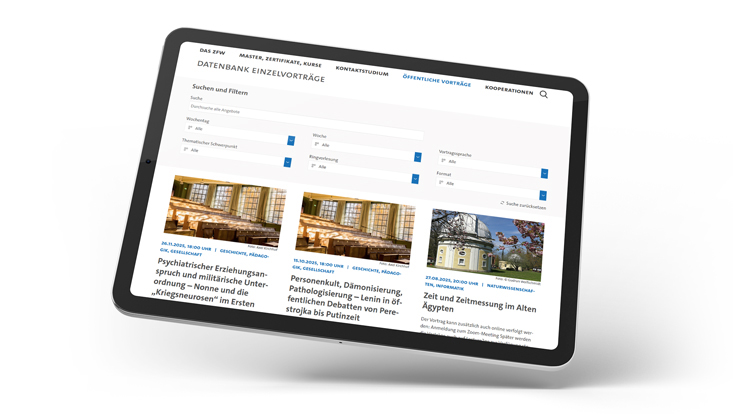
Foto: UHH
Alle öffentlichen Vorträge finden Sie einzelnen auch in unserer Datenbank. Dort können Sie nach Wochentagen, thematischem Schwerpunkt Format u.a. filtern.
Datenbank Einzelvorträge